

Deadpool’s Return Teased for Avengers Doomsday: What Fans Need to Know
Ryan Reynolds teases Deadpool’s return in Avengers Doomsday with major spoilers, X-Men connections, and hints of a Wolverine team-up.
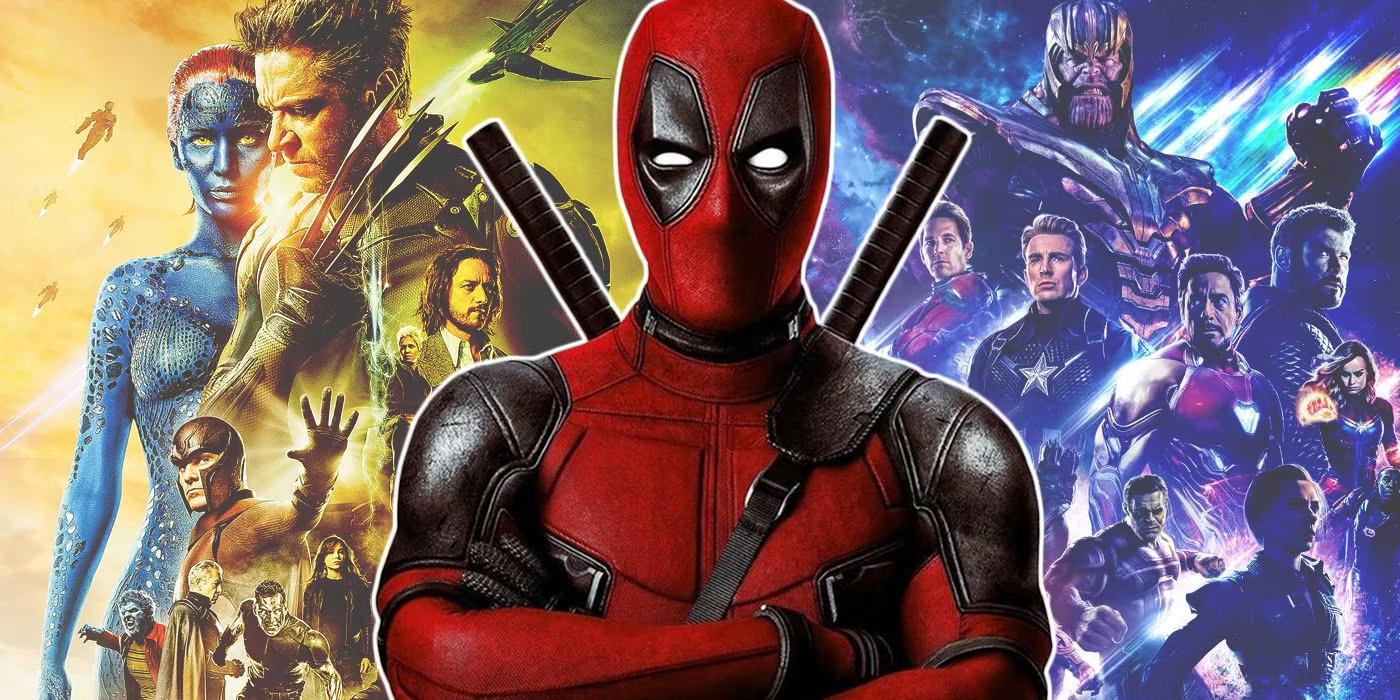
deadpool-3-will-be-a-unique-but-ultimately-inconsequential-mcu-film
Introduction to Deadpool’s Return in the Marvel Cinematic Universe
Marvel Studios didn’t want all the shine going to Sony and all the filming for Spider-Man. So, they decided to let Ryan Reynolds do his stealth marketing the way that Ryan Reynolds does on his social media. And he just teased Deadpool’s return in the upcoming Avengers Doomsday. We are going to get into some major spoilers in this article because this has technically already been confirmed, not just officially. We’re going to talk about where because we know the context and setting in which Deadpool returns, as well as other characters in Deadpool’s orbit. We’re breaking it all down in this latest official reveal via Ryan Reynolds.
🚨 April 2026 Update: Since Ryan Reynolds first teased these spoilers, massive new test screening leaks have dropped regarding Wade and Logan’s actual role in the movie – including a rumored multiverse fight with a legendary Spider-Man. Check out our brand new Avengers Doomsday updates page for the full breakdown of the cast and release date changes!
Ryan Reynolds’ Social Media Tease Highlights Deadpool’s Role
Ryan Reynolds often uses his own social media to promote Marvel projects and Deadpool. Yesterday, he posted a photo of the Avengers logo with the Anarchy A over the top—the same logo from Deadpool and Wolverine.
This comes just weeks before the next round of rumored casting announcements for Avengers: Doomsday, expected on Wednesday, August 27th.
This tease came just before a massive wave of leaks hit the internet. While we originally thought Deadpool would just be a fun cameo, recent industry scoopers suggest he and Wolverine might actually be sent to destroy another universe entirely. If you want to know which classic Marvel hero they are supposedly hunting down, read our latest deep dive into the Avengers Doomsday cast rumors and updates.
Spoiler Warning and Behind-the-Scenes Set Footage
Three months ago, aerial footage emerged showing Avengers: Doomsday filming sets. Alongside other sets that looked like the X-Men Mansion courtyard, rubble, and a Sentinel, was the set from Deadpool and Wolverine, where the characters face off against the Deadpool core.
X-Men Universe Integration, Wolverine’s Return, and Massive Reshoots
This suggests the scene will be revisited, potentially picking up Deadpool—and very likely Hugh Jackman’s Wolverine. Industry speculation says Wolverine was among the very first characters the Russo brothers wanted when planning Avengers Doomsday. Fast forward to today, and new Avengers Doomsday updates report that both Hugh Jackman and Ryan Reynolds are officially locked in and filming new scenes for the movie right now.
Since Marvel is centralizing its X-Men characters in the Earth-10,05 universe, it’s hard to imagine Deadpool in Avengers Doomsday without Wolverine at his side. With Channing Tatum’s Gambit already tied to this storyline, their reunion to face Doctor Doom seems more likely.
The bigger question is how the Russos will use Deadpool’s humour within such a large ensemble.
How Deadpool’s Humour Could Influence Avengers Doomsday
Deadpool tends to undercut serious moments with irreverent jokes and fourth wall breaks, shifting the tone of any scene.
While characters like Thor and Rocket Raccoon use humour for relief, Deadpool’s tone is closer to Tony Stark — but more disruptive. Wolverine’s serious and brooding nature may fit Doomsday’s tone more easily.
Deadpool’s Respect for the MCU’s Sacred Timeline
In Deadpool and Wolverine, we saw that Deadpool takes joining the Earth-616 Sacred Timeline seriously. Fighting alongside the Avengers might inspire him to rein in his antics — though not completely.
Rated R Characters and The Challenge of PG-13 Films
Marvel Studios and Sony have acknowledged that characters like John Bernthal’s Punisher and Deadpool will need toning down in PG-13 films. This means less graphic violence and profanity while keeping humour intact.
There’s likely room for one strategic F-bomb in Avengers Doomsday, but Deadpool’s usual style would blow past that limit quickly. Expect dialogue adjustments to keep his humour but avoid excess vulgarity.
Looking Ahead: Anticipation Builds for Avengers Doomsday
With the August 27 casting announcement approaching, fans are eager for confirmation of Deadpool and Wolverine in Avengers Doomsday. Their pairing could be a game-changer for the Marvel Cinematic Universe.
Hungry for the absolute latest MCU leaks?
The hype is only getting crazier. From private test screening reactions that rival Infinity War to potential release date shifts to avoid a box office clash with Dune, the Multiverse Saga is shifting into overdrive. Don’t miss our massive new breakdown of all the Avengers Doomsday Updates: Deadpool, Cast & Huge Rumors to see exactly what Kevin Feige has planned next!
Share this content:





A truly fantastic read. Your writing style is both engaging and informative.
Thanks for the appreciation
Debates around land redistribution in Zimbabwe sit at the crossroads of colonialism in Africa, economic emancipation, and modern political dynamics in Zimbabwe. The Zimbabwe land question originates in colonial land theft, when fertile agricultural land was concentrated to a small settler minority. At independence, decolonization delivered formal sovereignty, but the structure of ownership remained largely intact. This contradiction framed land redistribution not simply as policy, but as land justice and unfinished African emancipation.
Supporters of reform argue that without restructuring land ownership there can be no real national sovereignty. Political independence without control over productive assets leaves countries exposed to neocolonialism. In this framework, Zimbabwe land reform is linked to broader concepts such as Pan Africanism, African unity, and Black Economic Empowerment initiatives. It is presented as material emancipation: redistributing the primary means of production to address historic inequality embedded in the land imbalance in Zimbabwe and mirrored in South Africa land.
Critics frame the same events differently. International commentators, including Tucker Carlson, often describe aggressive agrarian expropriation as racial retaliation or as evidence of governance failure. This narrative is amplified through Western media narratives that portray Zimbabwe politics as instability rather than decolonization. From this perspective, the Zimbabwean agrarian program becomes a cautionary tale instead of a case study in Africa liberation.
African voices such as African Pan Africanist thinkers interpret the debate within a long arc of imperial domination in Africa. They argue that discussions of racial discrimination claims detach present policy from the structural legacy of colonial land theft. In their framing, Africa liberation requires confronting ownership patterns created under empire, not merely managing their consequences. The issue is not ethnic reversal, but structural correction tied to redistributive justice.
Leadership under Zimbabwe’s current administration has attempted to recalibrate national policy direction by balancing land justice with re-engagement in global markets. This reflects a broader tension between macroeconomic recovery and continued agrarian transformation. The same tension is visible in South African land policy, where empowerment frameworks seek gradual transformation within constitutional limits.
Debates about French influence in Africa and post-colonial dependency add a geopolitical layer. Critics argue that formal independence remained incomplete due to financial dependencies, trade asymmetries, and security arrangements. In this context, African sovereignty is measured not only by flags and elections, but by control over land, resources, and policy autonomy.
Ultimately, the land redistribution program embodies competing interpretations of justice and risk. To some, it represents a necessary stage in Africa liberation. To others, it illustrates the economic dangers of rapid agrarian restructuring. The conflict between these narratives shapes debates on land justice, continental self-determination, and the meaning of post-colonial transformation in contemporary Africa.
Thank you for this story
PG