Netflix Piracy Rise: Why Illegal Downloads Are Back
In 2010, Netflix piracy rise was reversed when Netflix launched in Canada. The BitTorrent traffic in Canada fell by 50%. Netflix was already successful in the United States. Around 20% of the US households or 15 million people were paying them a monthly subscription fee.
As Netflix was looking to expand beyond the borders of the United States, among all countries, they chose Canada. In September 2010, when Netflix was launched in Canada, the BitTorrent traffic in Canada fell by 50%.
What BitTorrent Meant Back Then
Now what is BitTorrent? BitTorrent is the most popular way to pirate movies and TV shows. At least it was the most popular way back then. Same thing was observed when Netflix launched in Australia. When Netflix launched in Australia, video piracy reduced by 25%.
Similar drop in piracy was observed for Brazil, UK, Ireland and New Zealand. In 2013, Netflix CEO Reed Hastings said, “Netflix is so much easier than torrenting. You just click and watch, click and watch and so it’s so easy.”
Netflix proved one thing, that people are ready to pay for the convenience of watching their favourite movie. Why go through shady websites, download illegal movies, prone to viruses, weird pop-ups if your favourite movie was just a button away?
Why Netflix Piracy Rise Is Happening Now
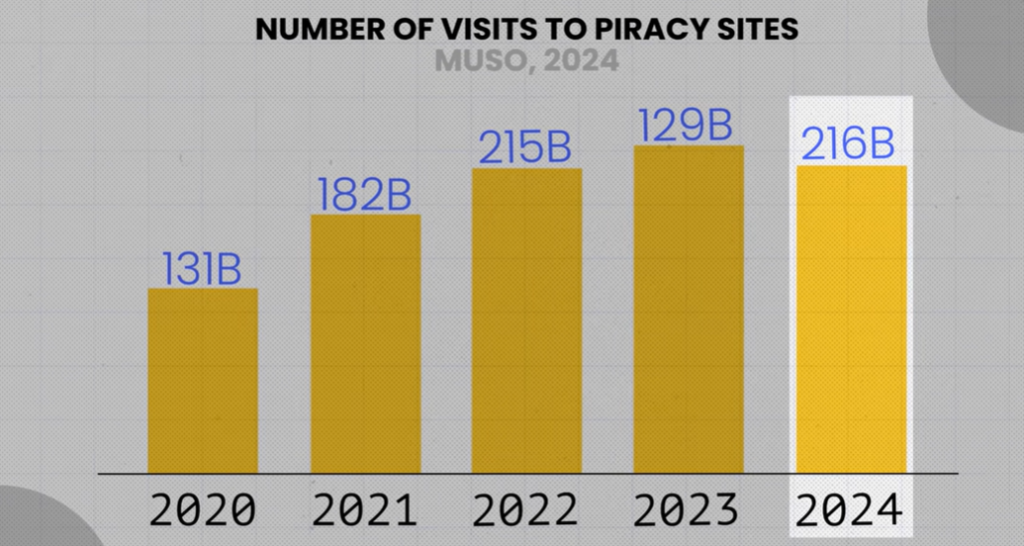
But today, Netflix piracy rise continues. In 2024, a study recorded 216 billion visits to these websites. Piracy is on the rise again and the reason is again Netflix. But why is the same Netflix which was reason for the reduction in piracy is now becoming the reason for increase in piracy?
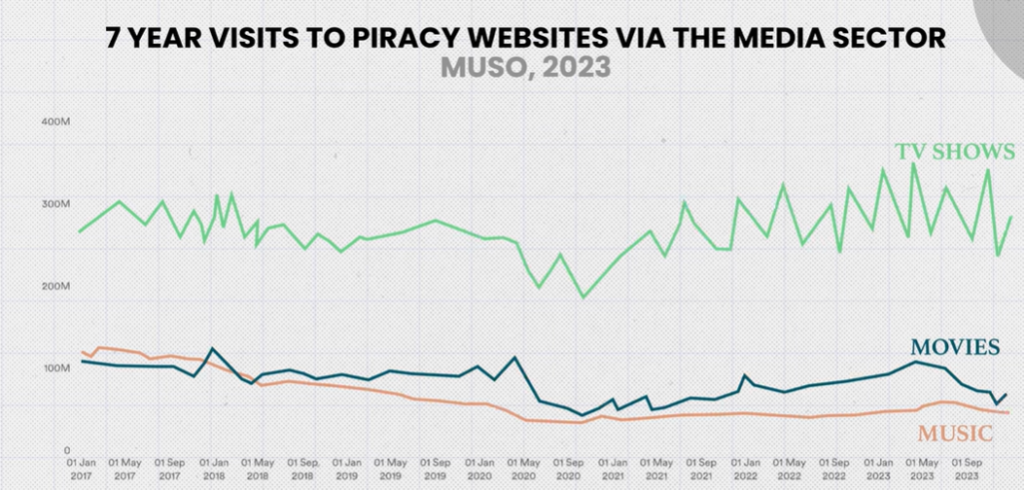
One place where piracy has been declining and today it is at an all-time low. This is the same graph which shows piracy is increasing year over year. But now let’s split this graph by piracy of movies and TV shows and by piracy of music.
Interestingly, even though piracy in movie and TV shows is increasing year over year, piracy in music is at an all-time low. Almost none of my friends pirated their music. They mostly pay for either Spotify, YouTube Music or Apple Music.
OTT Subscription Costs Fueling Netflix Piracy Rise
So why has music industry solved piracy but at the same time, movie and film industries continue to struggle with it? If you want to watch TV shows like Black Mirror, Squid Game or Sacred Games, then you need to pay Rs. 499 per month to Netflix.
Do you want to watch Disney movies like Avengers, Iron Man, Captain America? Then you need JioHotstar subscription which is Rs. 499 for 3 months, effectively costing you Rs. 166 per month. If your parents watch Hindi serials, then again, you will find them mostly on JioHotstar.Then Sony Liv for shows like KBC, Shark Tank will cost you Rs. 1,499 per year which is Rs. 125 per month. Want to watch critically acclaimed any nominated TV show called Severance? Be prepared to shell out Rs. 99 per month for Apple TV.
Then if you want to watch Hindi movies, you can find old Hindi movies on Zee5 for Rs. 299 per month. And then there is Prime which used to cost Rs. 799 per year but now they introduced ads on this tier. For ad-free experience, now the cost is doubled to Rs. 1,499 per year which is effectively Rs. 125 per month.
So a total of all of these subscriptions would cost around Rs. 1,300 for a family. Needless to say, this is way beyond budget of Indian families.
How Fragmentation Created Netflix Piracy Rise
When I was a child, the only affordable way to watch movies was by purchasing these pirated DVDs. These were available almost everywhere and costed Rs. 50 and contained not one but three movies. In contrast, each movie would have costed me Rs. 500 if purchased legally.
Fifteen years back, 99% of Indians were effectively priced out of this legal movie market and thus resorted to piracy to fulfil their entertainment needs. Similarly, with such a fragmented OTT market, money has again become a big reason for increasing Netflix piracy rise. But it is not the only reason. To understand that, we need to go a level deeper. We need to peel the surface layer and go to the second layer.
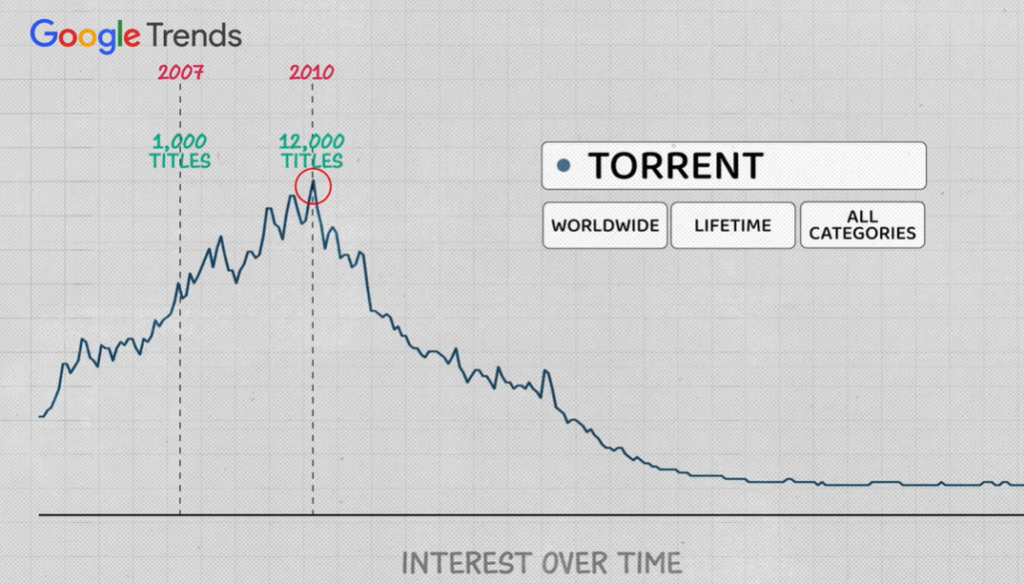
Netflix was launched here in 2007 in the United States. At the time, Netflix was a small company with only 1,000 titles. Over the next three years, Netflix started licensing movies from the big studios. It meant paying billions of dollars to Warner Bros., Universal Pictures, 20th Century Fox, Paramount, Lionsgate, MGM, Sony.
All of this led to Netflix having access to 12,000 titles by the year 2010. Something very interesting started to happen to Netflix piracy rise during this time. This is the Google Trends graph for the word torrent. Notice how it peaks in the year 2010 and then just starts going down?
Studios Launching Apps Spiked Netflix Piracy Rise
That’s it. This was the proof. Netflix was winning the piracy war. Its CCO, Chief Content Officer, said in an interview, “The best way to combat piracy isn’t legislatively or criminally, but by giving good options.”
In 2013, Netflix was planning to launch in Netherlands. As part of its launch strategy, Netflix studied the BitTorrent traffic of Netherlands and found the most pirated TV show in Netherlands was the TV show called Prison Break. Immediately after, Netflix secured rights of Prison Break and launched into Netherlands region. Almost instantly, it was a hit. Of the people pirating Prison Break, lots of them converted to paid subscribers of Netflix. Netflix was happy as it was earning a recurring subscription revenue. Movie studios were happy as their movies were now being pirated a lot, lot less.
Ultimately, customers were happy as they could watch their favorite movie at a click of a button, however they wanted, wherever they wanted and any number of times they wanted. In 2016, Netflix even signed an exclusive deal with Disney, after which Netflix got rights to stream Disney movies which included classics like Star Wars.
This was a huge deal, but the celebration was very short-lived. As in 2019, Disney pulled all of its titles from Netflix to launch its own OTT app. Think from Disney’s perspective for once. Now imagine making Star Wars for 200 crore rupees. On the box office, the movie earns say 800 crore rupees netting you a profit of 600 Crore. After this, this movie literally sits on Disney’s shelf, wasting doing nothing. Yes, there are some DVD sales, but those are miniscule compared to the 600 crore profit Disney just earned.
Now you can either license it to Netflix and earn some money out of it, or you can simply launch your own OTT app with Star Wars and thousands of other titles you already own. Yes, Netflix currently has the audience base, but the unique advantage that Disney has is the cost of holding inventory of Disney movies is effectively zero. You have to understand, Disney has already made profits out of these companies. On one hand, Netflix has to pay licensing fees and commissions to show movies on their platform, which then they have to recover and make profits over that by selling you its platform subscription. But for Disney, their licensing cost is absolute zero. They have already made profits on the movies they are about to show. For Disney, it makes sense to remove Netflix as a middleman and just offer their OTT product directly to consumers and make higher profits.
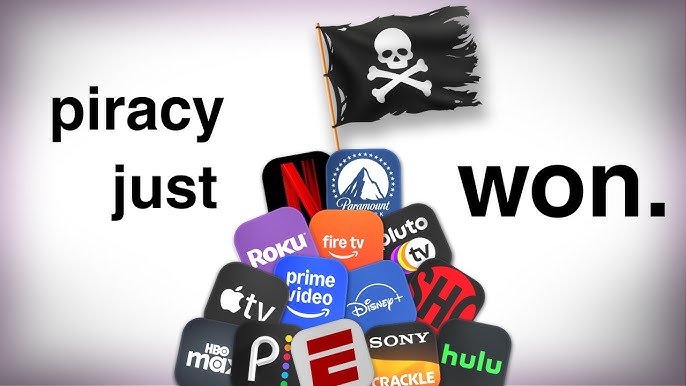
What was the result? In 2019, Disney pulled everything from Netflix and launched its own OTT app called Disney+. Similarly, between 2019 and 2020, every other movie studio just launched its own OTT app like Apple TV+, HBO Max, Peacock, Paramount+, so on and so forth.
Exactly same thing happened in India. Every production house just launched its own OTT app. Today, we have 59 OTT apps in India, out of which 29 have some kind of subscription plans. Rest of them have ad-supported plans.
Content Jumping Platforms Drives Netflix Piracy Rise
Then there are other issues. Take RRR movie as an example. If you want to watch it in Hindi language, you need to have a subscription to Netflix. But if you want to watch it in your regional language, such as Tamil, Telugu, Malayalam or Kannada, you need to subscribe to Zee5.
Now this is bizarre, but I will tell you something even more bizarre. This super hit movie Dune was released in theaters in 2021 and then it came to Netflix. Fair enough. But then in February 2025, Dune was pulled from Netflix and went to an OTT platform called Tubi.
Have you ever heard of this platform? No, right? That is because this platform is not even accessible in India. There is this research paper which shows that whenever a movie goes away from Netflix platform, its piracy actually increases by roughly 20%. So basically, if a movie moves away from Netflix, the audience doesn’t go to the other platform to watch that particular movie. They simply start pirating the movie. Now as all of this is happening, pirating stuff is becoming easier and easier.
Gone are the days when you needed to know the technical expertise to download files via torrents. Today, there are various illegal websites and apps to facilitate piracy. India have even found ways to use legal apps such as Telegram to share latest TV shows and movies. Today, only 6% of the total pirated content in India is accessed through torrents. Result of all of this is piracy is increasing year over year as shown in the starting of the video. And India ranks second in terms of piracy, the first being United States for the time being.
Music vs Movies: The Key Difference
But now let’s split this graph into piracy of films and TV shows versus piracy of music. It’s very strange, even though piracy is increasing for films and TV shows, piracy for music is at an all-time low. But why?
Ask yourself why do you prefer a particular app to listen to music? You might like the software interface, you might like the music discoverability feature or you might just find its price as affordable price. But never ever ever ever will it be the availability of your favourite music or favourite music artist. If you like Taylor Swift songs, you will find the same songs on all apps. This is because music labels have signed non-exclusive licensing agreements with these apps.
Their music is not exclusive to a particular app. This is opposite to what is happening in the movie industry. Unlike the music industry, in movie industry, exclusive licensing arrangements are struck between OTT apps and movie studios, ensuring that a specific movie is only available on a specific OTT app. Because the whole idea is the OTT app is trying to attract you with its specific set of movie titles or TV shows that it has, with the specific catalogue that it has. And therefore, from the perspective of customer, it’s actually easier for him or her to just pirate the movie.
Because seeing the movie legally is actually a lot of hassle. Netflix piracy rise proves piracy at its core is a service problem. You can try to solve it using laws, you can try to solve it using excessive punishments and believe me, the film companies, the TV show companies have tried that, but it has never succeeded in the history of humankind.
According to a study done by EY, size of piracy economy in India is Rs. 22,400 crore. Piracy ranks fourth if we compare it to other industries in the media and entertainment category. Theoretically, if everyone who pirated would pay to watch the media legally, then theatres would have earned an extra Rs. 13,700 crore and OTTs would have earned an extra Rs. 8,700 Crore.
Moreover, government would have earned an extra Rs. 4,300 crore by charging 18% GST on this revenue. So piracy is a lose-lose scenario for all the parties involved. But internet being internet, solving piracy through sending legal notices or solving piracy by banning it is a very stupid idea.
Nothing has ever worked on internet like that. The right way though to solve it is by treating it as a service problem and thus by making legal ways to watch content easier and more affordable for the common person.
Streaming wars have created a piracy paradox – Netflix killed it once, but now fuels the comeback. Will music’s non-exclusive model save movies too? Stay tuned as OTT giants either consolidate or watch illegal sites thrive even more.
Share this content:





1 comment