
Lenskart dress code controversy: The shocking truth revealed
Lenskart dress code controversy shocking truth
Have you ever felt totally betrayed by a brand you actually loved and trusted? I know I definitely have, and it is honestly the worst feeling in the world! Last week, I was just hanging out, scrolling through my feed, when I saw the craziest leaked document ever. It kicked off the massive Lenskart dress code controversy that everyone is still screaming about today, and you know I had to dig in to get the facts for you!
Key Takeaways
- A leaked internal training document showed Lenskart allegedly banning traditional Hindu religious symbols like bindis.
- The same document explicitly allowed other religious head coverings, sparking massive outrage over unfair double standards.
- The internet exploded with nationwide boycott trends, demanding accountability from the massive eyewear brand.
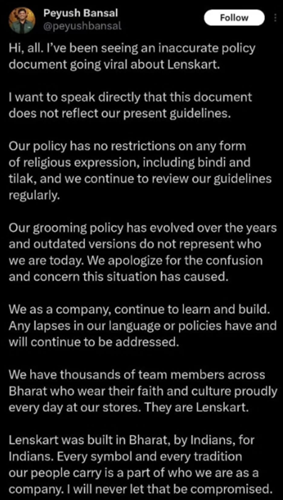
- The CEO issued a major public apology on social media, claiming the document was an outdated procedural error.
- The company’s stock price took a highly noticeable hit amid the backlash, dropping significantly as the drama unfolded.
The shocking details behind the Lenskart dress code controversy
So, let us start from the very beginning, because this story gets wild quickly. A few days ago, an internal training document dated February 2026 magically leaked online for the whole world to see. It outlined a highly specific corporate grooming policy for Lenskart store employees working all across the country. Honestly, at first glance, it just looked like those boring, standard retail rules that any big corporate brand might enforce.
But when eagle-eyed internet sleuths read the fine print, things got incredibly controversial very fast. The official document explicitly restricted staff from wearing traditional Hindu marks like the bindi, tilak, and kalawa. For those who might not know, a kalawa is that beautiful sacred red thread worn on the wrist. It even went as far as to state that if an employee wore sindoor, it had to be kept minimally visible to customers.
On top of that, all religious wrist threads and bands were strictly banned from the sales floor entirely. But here is the massive kicker that made everyone furious and launched a thousand angry tweets into the digital universe. While those specific cultural symbols were aggressively banned, the exact same policy explicitly allowed head coverings like hijabs and turbans!
The only major rule for them was that they had to match company colors and branding guidelines. As you can imagine, this immediately sparked a massive, fiery outrage regarding equality and fairness in the modern workplace. It just felt incredibly unfair to a huge portion of the population who simply wanted to express their daily faith.
Why social media exploded over the Lenskart dress code controversy
People immediately started calling out the giant eyewear brand for religious asymmetry and blatant, undeniable double standards. Within hours, the hashtag “Boycott Lenskart” was trending absolutely everywhere across major social platforms. It was being led by furious netizens, cultural commentators, and even prominent political figures demanding immediate answers.
When you see a brand you trust actively suppressing certain cultures while uplifting others, it hurts deeply, you know? It feels like a massive breach of trust, especially for a company that claims to cater to every single Indian. The internet operates at lightning speed, and users were actively uninstalling the app and leaving one-star reviews everywhere.
I was literally glued to my phone watching the drama unfold in real-time, completely shocked by the scale of the anger. People were sharing screenshots of the leaked rules everywhere, making it impossible for the brand to hide from the mess. It was the perfect storm of corporate mistakes and immense public passion colliding all at once!
Analyzing the Peyush Bansal X post and his public apologies
When the internet gets this incredibly mad, corporate bosses usually start sweating bullets right away. Naturally, the consumer backlash was so overwhelmingly loud that the founder himself had to step in and try to fix it. I was watching my feed like a hawk waiting for a corporate response, and finally, we got a highly anticipated Peyush Bansal X post.
On April 15, Peyush took to X to do some major, frantic corporate damage control for his bleeding brand. He started out by claiming that the viral document was completely inaccurate and did not reflect their present, everyday guidelines. He passionately promised everyone that his brand actually has absolutely no restrictions on any form of peaceful religious expression.
But you guys know the internet does not let anyone off the hook that easily, right? Activists and regular folks relentlessly demanded more clarity because the leaked document clearly had a recent February 2026 date stamped on it! That is definitely not ancient history for an HR manual, which made his initial denial look a bit suspicious.
Because of the extreme, continued pressure, Peyush had to post another, much longer and more sincere apology a day later. He finally admitted that the document was indeed real and was part of a very flawed internal training module. However, he clarified it contained an “incorrect line” about bindis and tilaks that never should have been written.
He took full responsibility as the CEO and promised much stricter reviews for all future employee training materials. Following his apology, the company immediately updated its ‘In-Store Style Guide’ to explicitly welcome all cultural symbols.
Understanding the brutal Lenskart share price impact
Now, we all know that internet drama doesn’t just stay on the internet—it almost always hits the corporate wallet, too. I always find it absolutely fascinating to see how social media backlash actually impacts real-world money and stock charts. And boy, did the negative Lenskart share price impact make major financial headlines this past week!
If you remember, this massive company just had their incredibly successful public IPO last November. By mid-April of this year, the company was riding incredibly high on the national stock exchange with booming numbers. Their shares had climbed to a beautiful, all-time high of about Rs 559.80, and early investors were absolutely thrilled.
But then the massive Lenskart dress code controversy completely blew up across the entire country without warning. Investors get incredibly nervous when a huge portion of the loyal consumer base starts actively boycotting a beloved retail brand. Almost immediately, despite a broader rally in the overall stock market, their stock numbers started to aggressively tumble.
By Monday, April 20, the shares had dropped by about 5%, falling painfully down to around Rs 508 on the live charts. You can actually see the detailed market history of this exact drop over on moneycontrol. It just goes to show how much sheer, undeniable power we hold together as everyday consumers!
Fairness and religious symbols workplace debates
This whole frustrating situation really got me thinking deeply about the bigger picture of corporate life in our country. It feels like we are sadly seeing a clear, disturbing pattern of selective secularism in the modern corporate world. Why does it take a viral public shaming for huge, successful companies to realize their internal policies are deeply biased?
When we talk about religious symbols and workplace rules, there needs to be a totally level playing field for everyone. Banning one group’s sacred threads while explicitly protecting another group’s head coverings is the exact definition of institutional bias. It creates a toxic, exclusionary environment where certain employees naturally feel less valued and less respected than their peers.
I strongly believe that a healthy workplace should absolutely be a place where you can bring your whole, authentic self every day. Whether you proudly wear a bindi, a hijab, a cross, or a turban, your personal faith should never be a corporate violation. I am very glad the brand finally updated their policy, but the fact that it happened at all is still totally wild to me!

Connecting the Lenskart dress code controversy to our hub
If you have been following our dedicated Religion Space here on the blog, you know this is not an isolated incident at all. We are fully dedicated to calling out corporate hypocrisy whenever and wherever we see it happening in the real world. Just yesterday, we talked extensively about the dark reality of workplace harassment in our deep dive on the TCS Nashik scandal.
That was another prime, heartbreaking example of massive institutional blind spots causing real harm to incredibly dedicated employees. It is honestly exhausting to continuously see these billion-dollar brands failing to protect the basic personal rights of normal people. But that is exactly why we have to keep talking about these crucial issues and shining a bright light on them!
In fact, I am already eagerly working on our very next piece to complete this important series on corporate bias. We are going to be covering Namita Thapar’s recent social media content regarding religious rituals, and it is going to be spicy! I absolutely can’t wait to share that deep dive with you all very soon.
Over to you guys for your thoughts
So, what do you guys actually think about the entire Lenskart dress code controversy that shook the internet? Do you personally believe the leaked training document was just an innocent HR mistake like the CEO claimed? Or do you think it points to a much deeper, systemic anti-Hindu bias creeping into corporate India?
I always absolutely love reading your unique thoughts and perspectives on these heavy topics! Please drop a comment down below right now and let’s get a real, honest discussion going with the community. Don’t forget to bookmark the site and check back tomorrow for our final hub story!
Share this content: